
When you're trying to improve your lawn's drainage, the goal is simple: give that excess water somewhere to go. This might mean physically breaking up compacted soil through aeration, enriching heavy clay with organic matter, or even re-shaping the yard itself to guide water where you want it. In more serious cases, you might need to install systems like French drains to actively carry water away from soggy spots.
Why Your Lawn Stays Waterlogged
That squishy, sinking feeling when you step on your lawn after a rain is more than just an annoyance. It’s a red flag. When your lawn stays waterlogged, it's a clear sign that it's struggling to breathe, and its health is genuinely at risk. Standing water essentially suffocates the grassroots, cutting off the oxygen they need to thrive. This kicks off a whole chain of problems that can quickly turn a lush green turf into a sad, muddy mess.

Before you can fix it, you have to figure out why the water is sticking around. The real reasons are almost always hidden just beneath the surface.
The Challenge of Compacted Soil
More often than not, the prime suspect behind a waterlogged lawn is soil compaction. Years of foot traffic from kids and pets, the weight of the lawnmower, and even just time itself can squeeze soil particles together so tightly that there's no room left for air or water to move through. Your lawn's surface effectively becomes a hard, non-absorbent barrier.
I like to compare it to a kitchen sponge. A new sponge is full of tiny holes and soaks up water instantly. An old, dried-out one is hard and water just beads up and rolls off. Compacted soil is that old sponge, forcing rain to pool on top instead of seeping down to nourish the roots.
Here in Canberra, this problem is often amplified by our region's heavy clay soils. Clay particles are incredibly fine and love to stick together, which makes them highly susceptible to compaction.
A healthy lawn needs air just as much as it needs water. When soil is compacted, it chokes the grassroots and creates the perfect damp, stagnant breeding ground for moss and fungal diseases.
Improper Grading and Yard Slope
The slope of your yard—what we call its grade—is critical for managing water. Ideally, your lawn should have a gentle, almost imperceptible slope away from your house's foundation. This subtle incline is designed to guide rainwater naturally toward the street or a dedicated drainage area.
But many yards have imperfections that mess up this flow. You might have low spots or depressions where water inevitably collects, creating those stubborn puddles that hang around for days after a storm. Worse, sometimes the entire grade slopes towards the house. That’s a serious problem that can lead to a damp basement and even threaten your foundation.
What causes bad grading?
- Settling Over Time: The ground around a house can settle unevenly in the years after it was built, creating unexpected dips and valleys.
- Previous Landscaping Work: That new patio or garden bed might look great, but if it wasn't installed with drainage in mind, it could have accidentally created a dam.
- Natural Topography: Some properties are just built on land that doesn't have a simple, natural path for water to follow downhill.
Overwhelmed by Water Sources
Sometimes the issue isn't your soil or the slope, but the sheer volume of water being dumped onto your lawn. Our homes and neighbourhoods are designed to concentrate a surprising amount of water into very small areas.
Think about your roof. It collects thousands of litres of water during a heavy downpour. If your downspouts just dump that water right next to your foundation, that patch of lawn will be instantly swamped. Add in the runoff from your driveway, the patio, and maybe even a neighbour's property, and your turf can easily be overwhelmed.
This is especially true during Canberra's seasonal downpours when the ground is already saturated and simply can't absorb another drop. The result is that soggy, unhealthy lawn that’s crying out for a better way to handle the deluge.
Pinpointing Your Exact Drainage Problem
Before you grab a shovel and start digging trenches, let's figure out what’s really going on. It’s tempting to jump straight to a solution, but guessing the cause of poor drainage is a classic rookie mistake. It’s a surefire way to end up with a sore back, an empty wallet, and a lawn that’s still a swamp after a bit of rain.
The good news is you don’t need a science degree or fancy lab gear to play detective. A couple of dead-simple tests will tell you everything you need to know about what's happening under your grass. These checks help you work out if you’re up against simple surface compaction or a deeper, more stubborn problem with the soil itself.
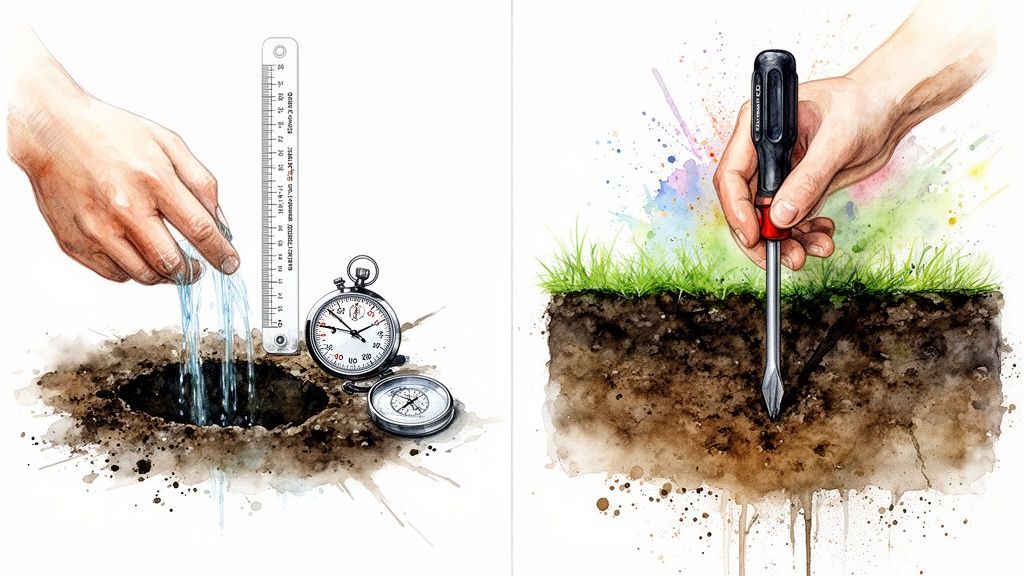
Uncovering Compaction with the Screwdriver Test
First things first, let's see how tight your soil is. This is the quickest and easiest test you can do, and all you need is a long screwdriver—one with a shank of at least 15 cm is perfect.
Head over to a spot where water usually pools and try to push the screwdriver into the ground using just your hand pressure.
- Goes in easily? If it slides in without much of a fight, compaction probably isn't your main issue. That's good news.
- Struggles to get in? If you hit a wall of resistance just a few centimetres down, you’ve found your culprit: compacted soil. This hard layer is acting like a concrete slab, stopping water in its tracks.
Do this in a few different places—the soggy bits and the drier areas. The comparison will give you a clear map of where the problem zones are.
Measuring Your Soil's Thirst with a Percolation Test
While the screwdriver test is great for spotting hardpan, the percolation test tells you how fast your soil can actually drink. It gives you a real, measurable drainage rate.
Here's how to run this simple experiment:
- Dig a hole in one of the waterlogged areas. You’re aiming for something about 15 cm wide and 30 cm deep—think the size of a large coffee tin.
- Fill the hole to the top with water and let it drain completely. This pre-soaks the surrounding soil so your test results are accurate and not skewed by bone-dry earth.
- Once the first lot has drained, fill it right back up again. This time, pop a ruler or measuring tape inside to mark the starting water level.
- Now, just check the water level every hour for the next four or five hours.
A healthy, well-draining lawn should see the water level drop by at least 2-3 cm per hour. If yours is moving at a snail's pace, you've got poor infiltration—a classic sign of heavy Canberra clay or serious, deep-seated compaction.
This test is incredibly revealing. If the water has barely budged after a few hours, you know that surface-level fixes like aerating might not cut it alone. You’ll likely need to consider more intensive solutions to fix the soil structure itself.
Lawn Drainage Symptom Checker
To make it even clearer, let's match what you're seeing in the yard with the likely cause. This table should help you connect the dots between your observations and the right first step.
| Symptom You See | Likely Cause | First Step to Try |
|---|---|---|
| Puddles that disappear slowly after rain | Soil Compaction from foot traffic, mowers, or construction | Core Aeration, Screwdriver Test |
| Water pools only in specific low-lying spots | Improper Grading (your lawn isn't sloped correctly) | Check levels with a string line, consider adding topsoil (topdressing) |
| The whole lawn feels spongy and stays wet | Heavy Clay Soil that holds onto water and doesn't let it pass through | Percolation Test, amending soil with gypsum or organic matter |
| Water gushes from downspouts onto the lawn | Poor Roof Water Management | Installing or extending downspout diverters away from the house |
| Grass is thin, yellowing, or has bare patches | Compaction & Poor Drainage are stressing the turf and starving its roots | Test for compaction and consider a full drainage improvement plan |
Hopefully, this gives you a solid starting point. By correctly identifying the "why," you can move on to the "how" with confidence.
Interpreting Your Detective Work
Okay, you've done the tests and have your clues. What does it all mean?
If you failed the screwdriver test and got a terrible result on the percolation test, you're almost certainly dealing with severe soil compaction. This is a double whammy that often leads to a thin, unhealthy lawn. If that sounds familiar, our guide on how to fix patchy grass has some great advice that works hand-in-hand with improving your drainage.
But what if the screwdriver went in easily, yet the water just sat there for hours? That points to a different problem. Your issue is likely the soil composition itself—probably a very high clay content—rather than just compaction. Knowing this is critical, as it changes your entire game plan.
DIY Drainage Fixes You Can Tackle This Weekend
Ready to roll up your sleeves and finally sort out that soggy lawn? The good news is, many drainage issues don’t require a full-scale excavation. With a bit of elbow grease, you can implement some powerful DIY fixes that dramatically improve water flow and bring your turf back to life.
Most of these methods focus on two key goals: opening up the soil to let it breathe and physically redirecting water away from problem areas. It’s a one-two punch that really works.
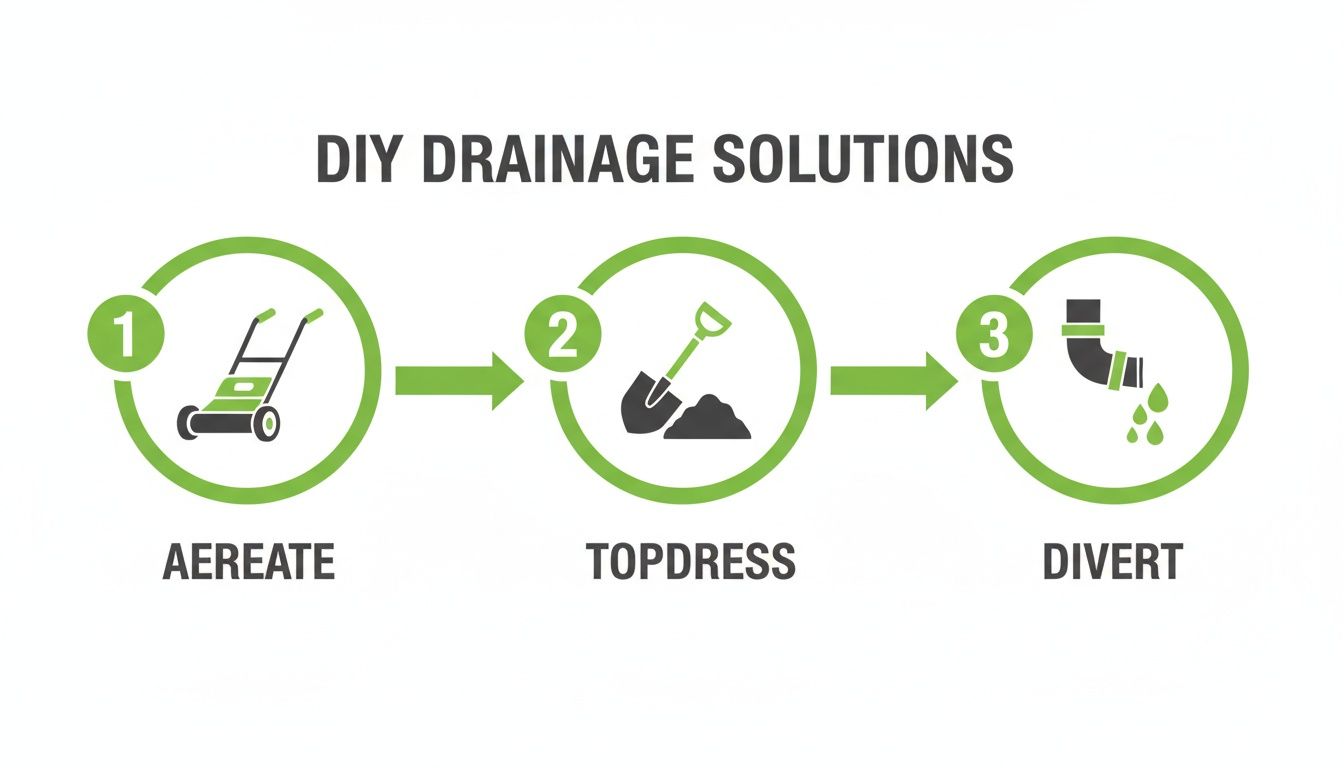
The best approach is to tackle the soil structure first with aeration and topdressing. Once you've created a healthier foundation, you can then focus on managing any external water sources contributing to the problem.
Start With Core Aeration
If your screwdriver test hit you with the cold, hard truth of compacted ground, core aeration is your first port of call. This isn't just about poking a few holes; it’s the real deal. A core aerator pulls out small plugs (or "cores") of soil, creating channels that let air, water, and nutrients get right down to the grassroots where they’re desperately needed.
For anyone with a Canberra garden, this is often the most impactful fix you can make. Our notorious heavy clay soils, found in over 70% of local lawns, are a nightmare for drainage. During a typical spring downpour, this waterlogging can cut your lawn's health by up to 50%. Core aeration is the perfect antidote, punching 10-15 cm deep holes every 10 cm or so, which can boost water infiltration by a massive 40-60% almost immediately.
You can easily hire a mechanical core aerator from a local equipment shop for a weekend. Just be sure to time it right—spring or autumn, when your grass is actively growing and will recover quickly.
Improve Soil Structure With Topdressing
Once you've aerated, it's time for topdressing. This simply means spreading a thin layer of a high-quality soil mix across your lawn. This new material works its way into the aeration holes, permanently improving the soil’s structure from the inside out. Think of it as adding better ingredients to your existing soil.
For Canberra’s clay, you can’t go wrong with a blend of coarse sand and rich organic compost.
- Coarse Sand: Be specific here—avoid fine builder's sand at all costs. It can mix with clay and turn your lawn into something resembling concrete. You need coarse, sharp sand to create larger particles and improve porosity.
- Organic Compost: This is your secret weapon. It adds vital nutrients and feeds the microbial life that helps break down dense clay over time.
A good ratio to aim for is roughly 70% sand to 30% compost. Spread a layer about 1 cm thick and use a lawn leveller or the back of a rake to work it into the holes. This is a long-term strategy that gradually transforms heavy, waterlogged soil into something much healthier. For bigger jobs, our guide on how to prepare soil for planting has more in-depth advice.
Topdressing isn't a one-and-done solution. See it as an annual treatment. Each application builds on the last, steadily improving your lawn's resilience and drainage capacity over several years.
Divert Water at the Source
Sometimes, the simplest changes make the biggest difference. Your roof is a massive water collector, and if your downspouts are dumping all that water right beside your foundation, you're essentially creating a personal swamp every time it rains.
Take a good look at your gutters and downspouts. Are they pulling their weight?
- Clean Your Gutters: First things first, get them clean. Gutters clogged with leaves and gunk will just overflow, sending a waterfall down your walls and saturating the ground below.
- Extend Your Downspouts: Most standard downspouts stop way too close to the house. Grab a flexible or rigid extender from the hardware store and push that water at least 1.5 to 3 metres away from your foundation. Aim it towards a part of the yard that drains better, or even towards the street gutter.
This quick fix can be done in under an hour and prevents thousands of litres of water from overwhelming your lawn. It’s a cheap, incredibly effective way to manage a major source of waterlogging without even touching the soil.
Advanced Solutions for Stubborn Puddles
If you've already tried the basics like aeration and topdressing but your lawn still resembles a swamp after every downpour, it's time to bring in the big guns. We're talking about more engineered solutions that tackle serious, persistent waterlogging at its source.
These aren't your typical weekend DIY fixes. They involve some real work, but the payoff is a permanent solution for those stubborn puddles, especially if you're battling heavy clay soil or a tricky sloped block.
Installing a French Drain
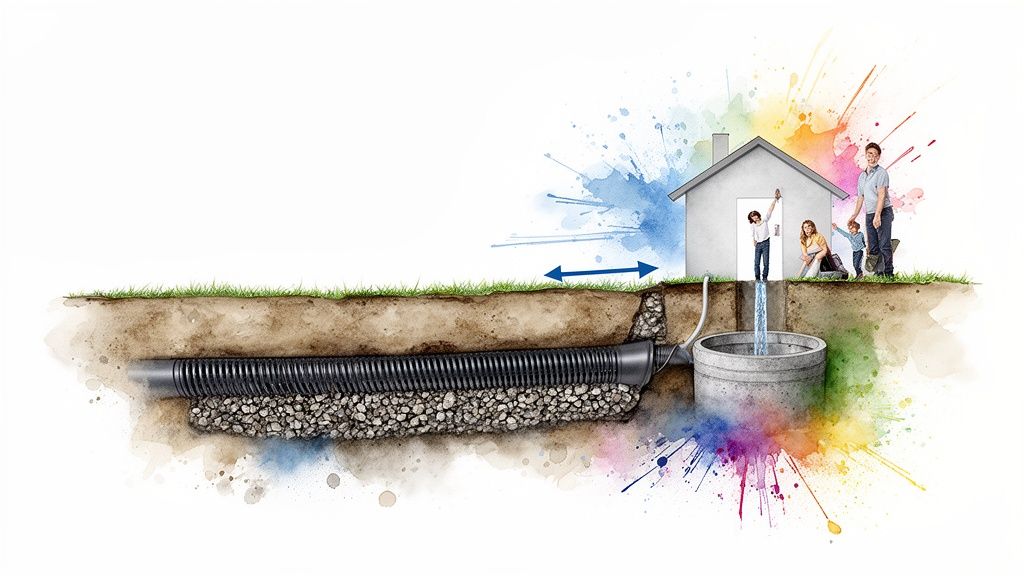
For widespread sogginess, a French drain is one of the most effective tools in the arsenal. It's essentially a hidden trench that works underground to intercept and redirect groundwater before it ever has a chance to saturate your lawn's surface. Think of it as a subterranean highway for excess water.
This system is an absolute game-changer for yards where water pools in low spots or builds up against the house foundation. It involves digging a trench, laying down a perforated pipe surrounded by gravel, and then covering it all back up. Once it's done, it's completely invisible but works tirelessly under the surface.
So, how does it all come together?
- The Trench: You dig a trench that has a gentle, continuous slope, using gravity to do the heavy lifting.
- The Gravel: The trench is lined with landscaping fabric to keep soil out, then filled with gravel. This creates a porous channel for water to flow through freely.
- The Perforated Pipe: Nestled at the bottom of the gravel, this pipe collects all that water and channels it away to a safe discharge point, like a stormwater drain.
The real beauty of a French drain is that it doesn't just fix a single puddle; it effectively lowers the water table across an entire section of your yard, giving your turf's roots the air they need to thrive.
Using a Dry Well for Water Collection
Once you've collected all that water, where does it go? A dry well is a fantastic solution, particularly when you don't have an obvious or permitted place to discharge the water off your property. It's a large underground pit, usually filled with gravel or a pre-made chamber, that holds excess water and lets it slowly soak back into the deeper subsoil.
It essentially acts as a holding tank during a heavy downpour, capturing runoff from French drains or downspouts and releasing it gradually. This prevents a sudden torrent of water from overwhelming other parts of your yard. They're especially handy for managing water coming off hard surfaces like driveways and patios.
A dry well is a significant project that requires a fair bit of excavation. But if you're boxed in with nowhere for water to go, it offers a self-contained and environmentally sound way to prevent erosion and flooding.
This kind of thinking aligns perfectly with our local setup. Canberra’s massive stormwater network, with its 6,260 kilometres of pipes, shows how important it is to manage water properly at a residential level. The city's grassed floodways are designed to keep water velocities under 2 m/s, and we can apply similar principles at home. French drains, typically installed 30-50 cm deep, are perfect for our clay-heavy soils and are credited with preventing 80-90% of foundation erosion in ACT properties. To get a better sense of the bigger picture, you can learn more about how Canberra's stormwater network functions.
Managing Surface Water with Catch Basins
While French drains are brilliant for groundwater, catch basins are your go-to for tackling surface water head-on. A catch basin is basically a grated collection box that you install at a low point in your lawn. Water pours in through the grate, and an outlet pipe carries it away—often into a French drain or dry well.
Think of it as the plughole for your backyard. It's the perfect fix for quickly clearing standing water from very specific problem areas, like:
- That one persistent low spot in the middle of the lawn.
- The bottom of a slope where water always gathers.
- Paved or patio areas that turn into small ponds.
Often, the best approach is to use these systems together. You could install a catch basin right in the middle of a soggy patch and connect its outlet pipe to a French drain that runs along the edge of your yard. This one-two punch manages both surface and subsurface water at the same time, giving you a truly comprehensive fix for even the most challenging drainage issues.
When to Call in a Drainage Professional
While DIY fixes like aeration and topdressing can work wonders on many common drainage problems, some situations are just too big or too complex for a weekend warrior. Knowing when to put down the shovel and call in an expert isn’t admitting defeat—it's the smartest move you can make to protect your property and get a solution that actually lasts.
There are a few clear red flags that signal it’s time for a pro. Trying to push through these issues on your own can lead to wasted time, money, and potentially serious damage to your home and garden.
Persistent Issues Despite Your Best Efforts
You've aerated until your arms ached, you've topdressed with the best compost mix, you've even extended the downspouts. But after every decent rain, the swampy patches are right back where they started. If your hard work isn't making a dent, it’s a sure sign of a deeper problem that needs an expert eye.
A professional can see the bigger picture. They'll assess the overall topography of your property, understand how water is moving under the surface, and pinpoint issues that simply aren't visible to the untrained eye.
When your DIY fixes provide only temporary relief, it's a strong sign that the root cause is more significant than simple soil compaction. A professional assessment can save you from a frustrating cycle of repeating the same ineffective work.
Water Pooling Near Your Foundation
This is the big one. If you see water consistently pooling within a few metres of your house, don't wait. That standing water is putting immense hydrostatic pressure on your foundation, which can lead to cracks, basement leaks, and devastating structural damage over time.
A professional landscaper or drainage specialist knows exactly how to grade the area or install a heavy-duty system like a French drain to intercept and redirect that water safely away. This is one job where you can't afford any margin for error.
When Significant Re-Grading Is Needed
Sometimes the problem is baked right into the shape of your yard. If your property slopes towards your house or has major low spots, no amount of soil amendment is going to fix the fundamental issue. The only real solution here is re-grading—physically reshaping the land to create a gentle, positive slope away from your home.
This is a serious earthmoving job that requires specialised equipment like mini-excavators and laser levels to get the grade just right. A professional crew can get it done in a day or two, saving you from a monumental, back-breaking task.
They also understand the local soil quirks, which is absolutely critical around here. In Canberra, where 80% of lawns are sitting on clay that swells up when wet, professional systems are often the only reliable answer. A properly installed French drain can improve water percolation by 70%, and local data shows that 65% of residential fixes in the ACT involve these kinds of subsurface systems. When combined, expert solutions have been shown to reduce water damage claims by an incredible 85%. You can discover more insights about Canberra drainage solutions to see the real-world impact they have.
The Value of Professional Expertise
Hiring a professional isn't just about getting access to a bigger digger; it’s about their experience. An expert from a team like Canberra Platinum Gardening brings a lot to the table:
- Knowledge of Local Regulations: They know the ins and outs of council rules for stormwater management and runoff.
- Access to Proper Tools: They have the right machinery to do the job efficiently and correctly the first time.
- Guaranteed Results: A reputable company will stand by their work, which gives you genuine peace of mind.
If any of these scenarios sound familiar, getting an obligation-free quote is your best next step. It’s a small investment of time to get a clear diagnosis and a solid plan to finally reclaim your yard from the water.
Answering Your Lawn Drainage Questions
Once you’ve got a plan in mind, a few practical questions always pop up. It's completely normal. Let’s run through some of the most common things Canberra homeowners ask us, covering everything from timing and aesthetics to the big one: the budget.
Getting these details sorted helps you move forward feeling confident you're picking the right fix for your yard and your wallet.
How Often Should I Aerate a Clay Lawn?
In Canberra, we deal with a lot of heavy clay soil, and for that, core aeration is a game-changer. To keep that soil breathing and stop it from compacting back into a hardpan, you should aim to aerate at least once a year. The best time to do this is when your grass is actively growing in spring or autumn, as it will bounce back much faster.
Now, if your lawn is the go-to spot for backyard cricket, the kids, and the dog, it's taking a much bigger beating. For these high-traffic yards, bumping that up to twice a year—once in spring and again in autumn—can make a world of difference. It keeps the ground open and ready to absorb water, no matter the season.
Think of aeration as a regular health check for your soil. Sticking to an annual schedule is one of the best preventative things you can do to stop compaction from turning into a major waterlogging headache later on.
Will a French Drain Ruin the Look of My Lawn?
This is a concern I hear all the time, and thankfully, the answer is no. A properly installed French drain is completely invisible once the job is done. The whole system is designed to work out of sight, underground.
The process involves digging a trench, laying the perforated pipe, and backfilling it with gravel. The final step is to put the topsoil back on top and either lay new turf or reseed the area. Once the grass grows back in, you'll never know it's there. The only thing you'll notice is that the soggy, unusable part of your lawn is finally gone.
How Much Will It Cost to Fix My Drainage?
This is a "how long is a piece of string?" question, as the cost to fix lawn drainage varies massively depending on the solution.
- DIY Fixes: These are by far the most budget-friendly options. Renting a core aerator for the weekend or grabbing a few downspout extenders from the hardware store will only set you back a small amount. Topdressing is also quite affordable, with the main cost being the materials.
- Professional Installations: When you're dealing with more serious issues, the investment gets bigger. Installing a French drain or re-grading a section of your lawn requires labour, machinery, and expertise, so you're looking at costs in the thousands.
It's important to remember that while a professional job costs more upfront, it's a permanent fix for a chronic problem. Tackling it properly can save you a fortune in the long run by preventing far more expensive issues, like water damage to your home’s foundation.
Do I Need a Council Permit to Install a Drainage System?
For most straightforward drainage work on your own property, you generally won't need a permit. Things like French drains or dry wells that are designed to manage and disperse water within your block are usually fine.
However, it's a different story if your plan involves connecting to the public stormwater system or if the runoff could affect a neighbour's property. In those scenarios, you absolutely need to check with your local council to make sure you're following all the rules. This is where a professional contractor is worth their weight in gold—they know the regulations and can handle the permit process for you.
Ready to solve your lawn drainage problems for good? The team at Canberra Platinum Gardening has the local expertise to diagnose your issue and deliver a lasting solution. https://canberraplatinumgardening.com.au